
Out of Sync: Ventilator Inflating the Lung as the Patient Exhales

Updated: Nov 3, 2025
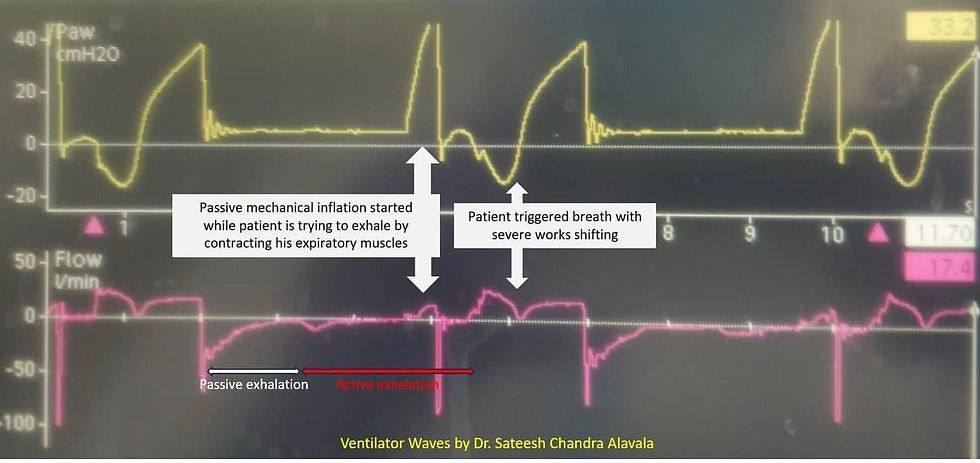
You can observe three pairs of breaths (double trigger) in this image. The first breath in double trigger is triggered by the machine, characterized by a rapid increase in pressure that reaches the pressure alarm limit, causing pressure cycling. The subsequent breath is a patient triggered mandatory breath. The pressure-time scalar deviates below the baseline due to strong inspiratory effort, known as work shifting. As the inspiratory muscles relax, the pressure-time scalar rises above the baseline.
Now, the question arises: what could be the reason for the sharp rise in pressure during the first breath?
This can occur if there is high airway resistance, especially if there is an obstruction in the endotracheal (ET) tube. However, such an obstruction should also affect patient-triggered breaths during both inspiratory and expiratory phases, yet those waveforms appear normal here.
Another important cause of this sharp pressure rise is active exhalation during the inspiratory phase of a mandatory breath. Normally, expiration is passive, driven by the elastic recoil of the respiratory system. Sometimes active exhalation can occur and the patient uses expiratory muscles. In this case, the patient was contracting his expiratory muscles, starting in the second half of the expiratory phase, as evidenced by a slight increase in expiratory flow. Meanwhile, the ventilator initiated a mandatory breath (time-triggered breath), while the patient continued to actively exhale, resulting in the sharp rise in pressure.
These findings were verified during the clinical examination. Expiratory muscle (abdominal) contraction was noticed by palpation of the abdomen. This continued until the onset of neural inspiration in the subsequent breath.
The term "early trigger" aptly describes this dyssynchrony: the ventilator initiates a breath while the patient is actively trying to exhale, occurring before the onset of neural inspiration. This waveform is similar to a reverse trigger, which is a type of early trigger: neural inspiration follows passive mechanical inflation.


Comments