
Failed Trigger Coinciding with Machine Trigger Breaths

Updated: Nov 5, 2025
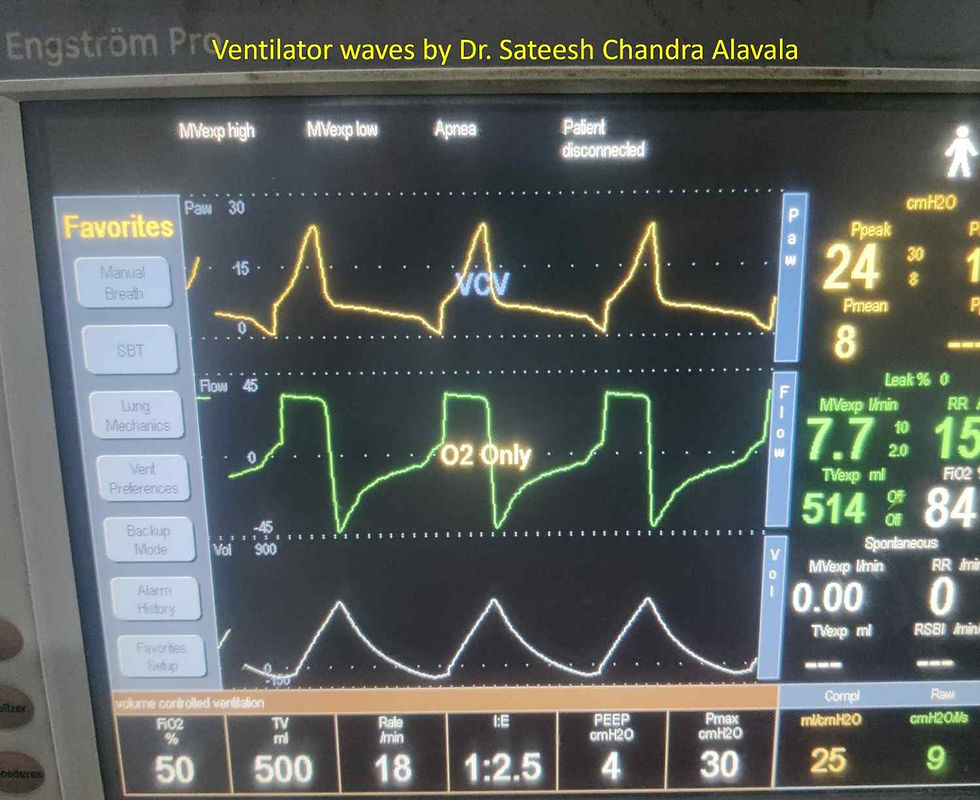
A patient-triggered breath is commonly recognized by a slight pressure drop just before inspiration. Many ventilators also provide visual cues—in this particular ventilator, patient-triggered breaths are highlighted in red on the ascending limb of the pressure and flow scalars.
In the waveform shown, there is a visible pressure drop prior to inspiration, giving the impression of patient-triggered breaths. However, the ventilator did not mark these breaths in red, raising the question of whether these were truly patient-triggered or whether a non patient signal was producing the pressure deflection.
Initially, the flow trigger sensitivity was set to 3 L/min. At this setting, the patient’s inspiratory effort was not strong enough to reach the trigger threshold. As a result, time-triggering occurred, and the breath happened to coincide with the ineffective patient effort, mimicking a patient-triggered breath.
When the trigger sensitivity was reduced to 1.5 L/min, the waveform appearance did not change—the efforts remained sub-threshold, so the ventilator continued to time-trigger the breaths.
Only when the trigger threshold was reduced further to 1 L/min did the patient’s effort successfully trigger the ventilator. At this point, the ventilator correctly labelled the breaths in red, confirming true patient triggering.
Key point:
At higher (less sensitive) trigger settings, the patient’s inspiratory effort was ineffective, giving the illusion of patient triggering because the effort coincided with a time-triggered breath.
When trigger sensitivity was increased, the same effort crossed the threshold and the ventilator correctly identified and labelled the breath as patient-triggered.


Comments