
Effect of Active Exhalation Valve on Waveform Morphology During Late Cycling

Updated: Nov 4, 2025
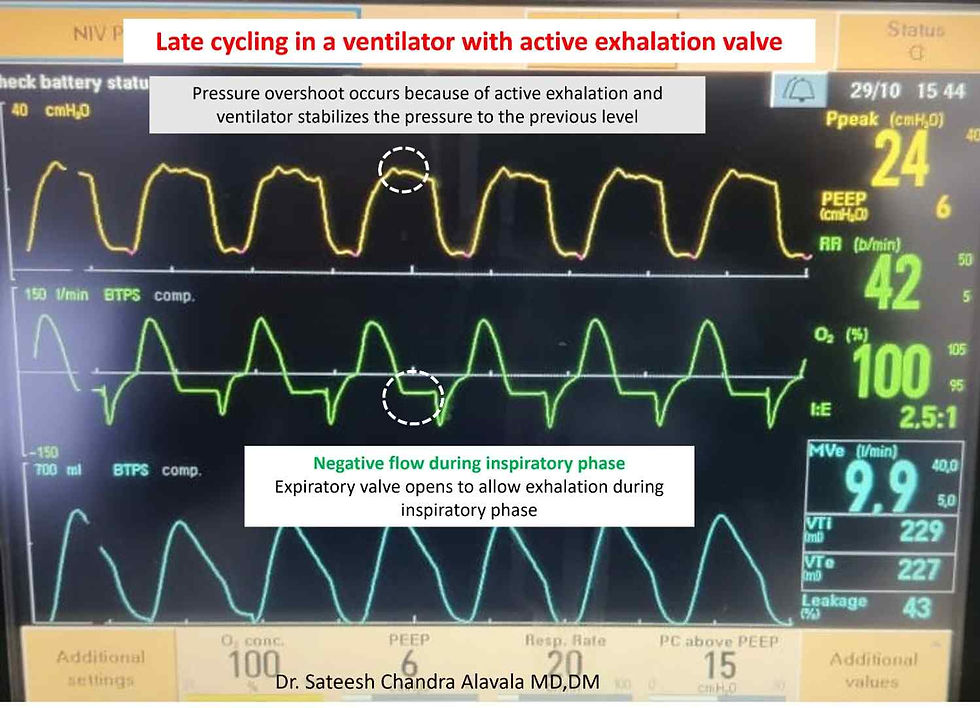
In pressure control mode, airway pressure remains constant throughout the inspiratory phase. However, if the patient attempts to exhale before the set inspiratory time ends, the pressure transiently rises above the set inspiratory pressure. This occurs when the patient's neural inspiratory is shorter than the ventilator's set inspiratory time- a phenomenon known as late cycling.
Late cycling can be recognized on ventilator waveforms by a pressure spike on the pressure-time scalar during inspiration, accompanied by a rapid return of inspiratory flow to baseline and a brief zero-flow period. In some cases, particularly when the ventilator has an active exhalation valve, the inspiratory flow even may cross the baseline, producing a brief negative flow as the patient begins to exhale.
The pressure waveform morphology also differs between these systems: with an active exhalation valve, the pressure tends to stabilize below the initial pressure spike, whereas in ventilators lacking this feature, the pressure remains elevated above the set inspiratory pressure until cycling to expiration occurs.




Comments